Why Google Reviews Matter for Local SEO
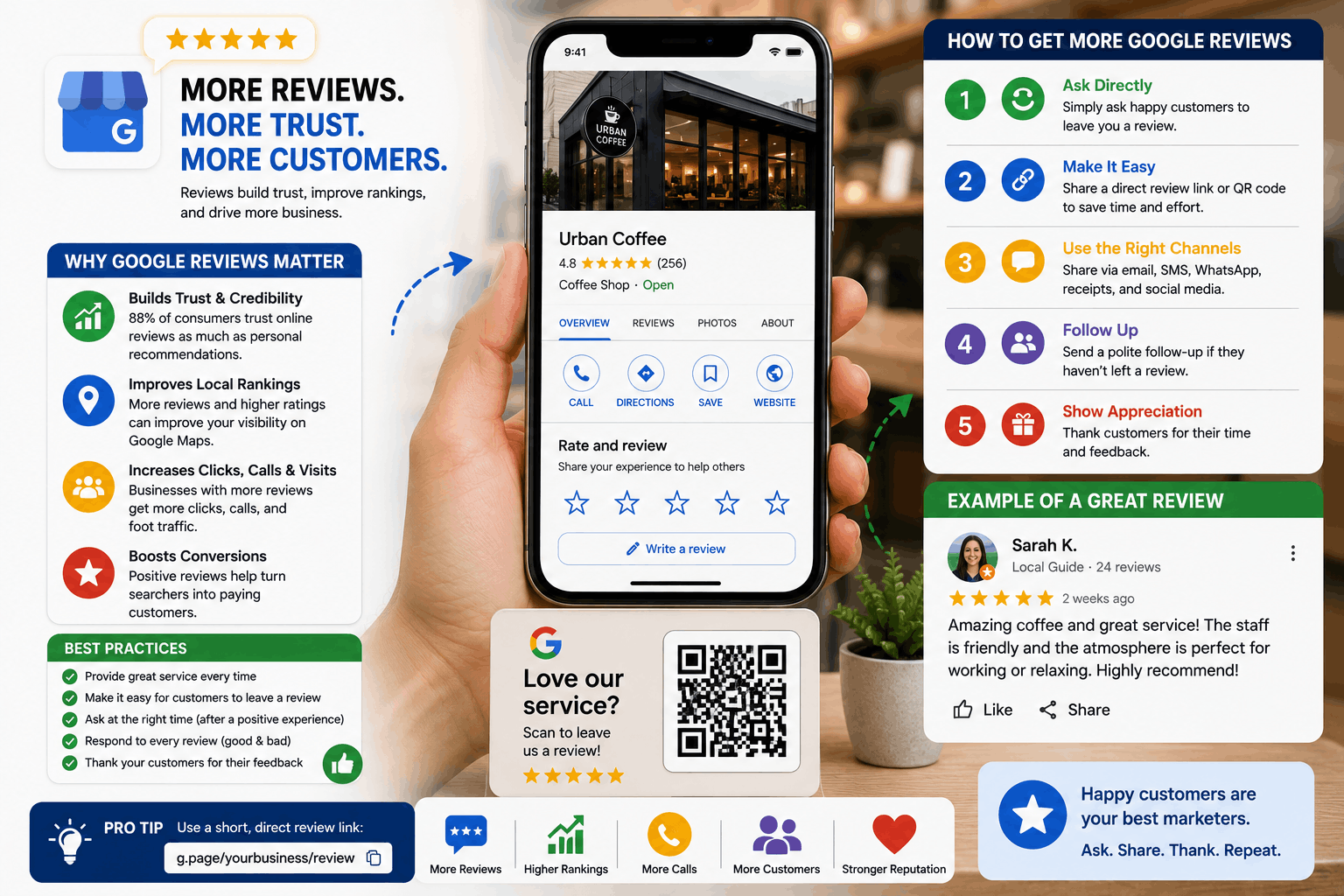

Google reviews are one of the most powerful — and most underused — local SEO assets a business has. They sit at the intersection of two things every business needs: search visibility and customer trust. A profile with strong reviews doesn’t just rank better; it converts better, because the people who find you already believe you’re worth contacting.
Reviews influence Google’s local ranking signals directly. Google has been explicit for years that review count and review score factor into local ranking, and in 2026 that influence has only deepened as review sentiment feeds into AI-generated answers and Maps recommendations. A business that ignores its review profile is leaving one of its strongest, lowest-cost ranking levers untouched.
2. Quick Answer: Do Google Reviews Help Local SEO?
Yes. Reviews improve local visibility, build trust, increase engagement, and lift conversion rates. Google uses review quantity, quality, recency, and relevance as local ranking signals — meaning a steady stream of recent, detailed, positive reviews tends to outperform a static, older review profile, even one with a higher overall count.
| Review Factor | Why It Matters |
| Quantity | Signals established, trusted demand |
| Quality (rating) | Reflects actual customer satisfaction |
| Recency | Shows the business is active and currently performing well |
| Relevance | Keyword-rich reviews confirm what you actually offer |
3. How Google Reviews Influence Local Rankings
Review Quantity
Businesses with a larger pool of authentic reviews generally perform better in local results, because volume signals sustained, real-world demand. A handful of reviews from years ago reads very differently to Google — and to customers — than a steadily growing collection.
Review Quality
Average rating is the most visible quality signal, but sentiment matters just as much. Reviews that describe a specific, positive customer experience (“fixed our hot water system the same day”) carry more weight than generic five-star ratings with no detail.
Review Recency
Fresh reviews tell Google — and prospective customers — that a business is currently active and consistently delivering. A profile that hasn’t received a review in eighteen months looks stagnant, even if its historical rating is strong.
Review Relevance
When customers naturally mention specific services in their reviews (“great emergency plumber,” “best teeth whitening in Parramatta”), it reinforces the same relevance signals as your GBP description and services — without you needing to write a word of it.
| Pro Tip You can’t script what customers write, but you can prompt it. Ask happy customers a simple, open question (“What made the experience easy for you?”) instead of a generic “please leave us a review” — it naturally produces more specific, relevant language. |
4. Reviews and the Local Pack
The Local 3-Pack — the three Maps listings shown above organic results for local searches — is largely won or lost on review profile strength. Two businesses with similar relevance can see very different click-through rates simply because one shows 4.9 stars from 340 reviews and the other shows 4.2 stars from 28.
Review profiles shape user behaviour before a single click happens. A strong rating and recent activity reduce hesitation, which is why review strength correlates so closely with both ranking position and the click-through rate once a listing appears.
5. Reviews Build Trust and Increase Conversions
Reviews function as social proof at the exact moment a customer is deciding whether to call, message, or drive past. A potential customer comparing two electricians with near-identical pricing will almost always choose the one with stronger, more recent reviews — because reviews reduce the perceived risk of an unfamiliar provider.
In practice, this shows up as higher call rates, more website clicks from the profile, and more direction requests — the three core engagement metrics GBP Insights tracks.
6. Reviews and AI Search
AI Overviews and other generative search experiences increasingly summarise reputation, not just list links. When an AI Overview answers “what’s the best-rated plumber in Parramatta,” it’s drawing on aggregated review sentiment — not a single page’s keyword optimization.
This means review sentiment is becoming a direct input into how generative engines describe and recommend businesses, on top of its existing role in traditional Maps and Search rankings. A business with consistently positive, detailed reviews is simply easier for an AI system to summarise favourably.
7. How to Get More Google Reviews Ethically
- Ask at the right time — right after a job is completed or a positive interaction, while satisfaction is fresh
- Use SMS and email follow-ups with a direct link to your review page
- Share your review link in invoices, email signatures, and on-site signage
- Train staff to mention reviews naturally at the end of a positive interaction
- Automate review requests through your CRM or booking software — without making them feel automated
Example: a dental clinic sending a same-day SMS (“Thanks for visiting today — mind sharing a quick review?”) with a direct link consistently outperforms a generic monthly email blast.
8. How to Respond to Reviews
Positive Reviews
Thank the customer by name where possible, and reference something specific from their review. “Thanks, Sarah! Glad the team could sort your hot water system the same day.” Specific replies reinforce relevance signals for future readers.
Neutral Reviews
Acknowledge the feedback directly and offer to resolve any unaddressed concern. “Thanks for the feedback — we’d love to know how we could have made the visit a five-star experience. Feel free to reach out directly.”
Negative Reviews
Stay calm, acknowledge the issue without being defensive, and move the conversation offline. “We’re sorry to hear this didn’t meet expectations. Please contact us directly at [phone/email] so we can make it right.”
9. Common Google Review Mistakes
- Buying reviews from third-party services
- Incentivizing reviews with discounts or free products
- Review gating — only directing happy customers to leave public reviews
- Ignoring negative reviews instead of responding professionally
- Asking every customer for a review at once in a single bulk campaign
| Common Mistake Review gating — quietly filtering which customers get asked to leave a public review — directly violates Google’s guidelines and can result in review removal or profile penalties if detected. |
10. Google Review Growth Checklist
- Review requests: automated, sent within 24 hours of service completion
- Response strategy: documented tone guidelines for positive, neutral, and negative reviews
- Monitoring: someone checks for new reviews at least every 48 hours
- Reporting: monthly tracking of review count, average rating, and response rate
- Team processes: staff trained on when and how to mention reviews to customers
11. Real-World Example
A local HVAC business with 45 reviews and a 4.1 rating introduced an automated SMS review request sent the same day as each service call, alongside a same-business-day response policy for all new reviews. Over six months, the review count grew past 210 with an average rating above 4.7.
Alongside that growth, the business saw stronger Local 3-Pack visibility for its core service terms and a noticeable increase in phone calls originating directly from its GBP profile — consistent with the broader pattern of review growth correlating with both ranking and conversion improvements.
12. FAQs
How many Google reviews do I need?
There’s no fixed number, but a steady, growing count — ideally with new reviews every week or two — outperforms a one-time push followed by silence.
Do reviews affect Google Maps rankings?
Yes. Review quantity, rating, recency, and relevance are established local ranking signals used alongside categories and engagement data.
Can negative reviews hurt SEO?
An occasional negative review is normal and rarely damaging on its own. A pattern of unanswered negative reviews, or a consistently low rating, can affect both rankings and conversions.
How often should I ask for reviews?
Continuously, but spaced naturally — right after each positive interaction, rather than in occasional bulk campaigns.
Should I respond to every review?
Yes. Responding to all reviews, positive and negative, signals an active, engaged business and reinforces trust for future customers reading them.
Is it okay to offer a discount for a review?
No. Incentivizing reviews violates Google’s guidelines, regardless of whether the incentive applies to positive or negative feedback.
Do reviews help with AI search results?
Yes. AI Overviews and generative search tools increasingly summarise review sentiment when answering “best” or “top-rated” style queries.
What’s review gating and why is it risky?
Review gating means selectively asking only satisfied customers to leave public reviews. It violates Google’s policies and can lead to review removal or account penalties.