Local SEO Tips for Service-Based Businesses
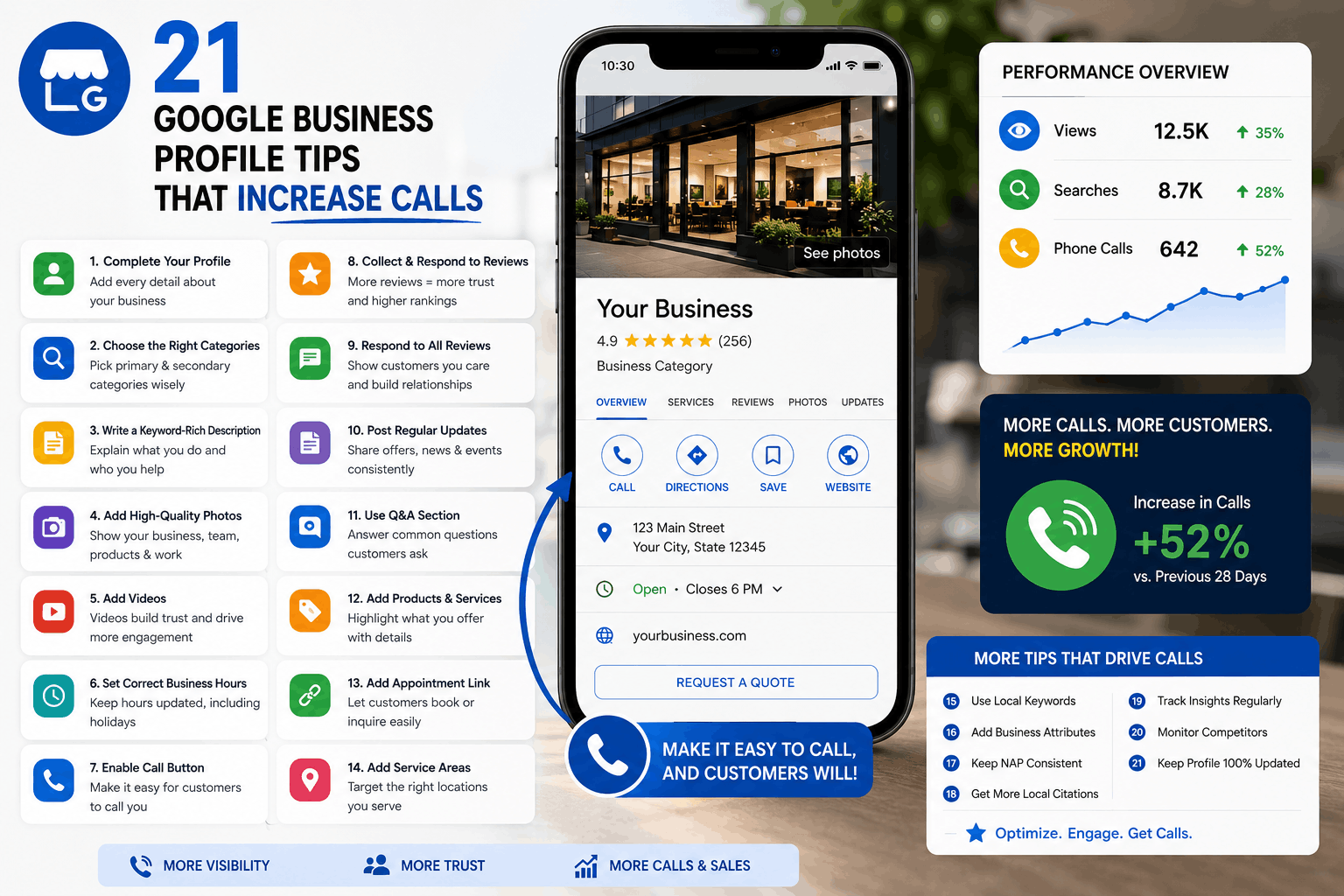

For service-based businesses, local SEO is consistently one of the highest-ROI marketing channels available — because it captures people at the exact moment they need help. Nobody searches “emergency plumber near me” out of curiosity; they search because a pipe is leaking right now.
That urgency is what makes Google Maps and local search results so valuable. A customer comparing three plumbers in the Local 3-Pack will usually call the most visible, most trusted option within minutes — not the one with the lowest price three pages deep in organic results. Visibility, in this category, converts almost instantly into leads.
2. Quick Answer: What Are the Best Local SEO Tips for Service-Based Businesses?
Fully optimize your Google Business Profile, build dedicated landing pages for each service, collect Google reviews consistently, keep your business information identical everywhere it appears, publish local content, and steadily build your website’s authority. None of these are one-time tasks — they compound when done consistently.
| Action | Primary Benefit |
| Optimize Google Business Profile | Stronger Maps visibility and trust |
| Build service-specific landing pages | Better intent match for each search |
| Collect Google reviews | Trust signals that drive calls |
| Maintain consistent NAP | Stronger citation authority |
| Publish local content | Relevance for AI and traditional search |
| Improve website authority | Supports rankings across all channels |
3. Fully Optimize Your Google Business Profile
Categories
Choose the single most accurate primary category for your core trade, plus genuinely applicable secondary categories — this is one of the strongest local ranking signals available.
Services
List every real service with a specific, intent-matched description — “Same-day blocked drain clearing,” not just “Plumbing.”
Business Description
Use the 750-character limit to clearly describe what you do, who you serve, and what makes you different — naturally, without stuffing keywords.
Photos
Upload real team, vehicle, and job-site photos regularly — generic stock imagery undermines trust instantly.
Reviews
A steady, growing flow of recent reviews is one of the clearest trust and ranking signals a service business can build.
GBP is critical for local visibility because, for most service businesses, it’s the first — and sometimes only — touchpoint a customer sees before calling.
4. Create Service-Specific Landing Pages
A homepage that lists “plumbing, electrical, and HVAC” in one paragraph can’t compete with a dedicated, conversion-focused page for each service.
- Individual service pages — one page per core service, not one page trying to cover everything
- Local intent optimization — include your service area naturally in headings and copy
- Conversion-focused content — clear pricing guidance, process explanation, and a strong call-to-action
Example: instead of one generic “Services” page, a roofing company builds separate pages for “Roof Repairs,” “Roof Replacement,” and “Storm Damage Assessment” — each targeting a distinct search intent.
5. Build Location-Relevant Content
- Local FAQs — answer the specific questions customers in your area actually ask
- Service area pages — a dedicated page per suburb or region you genuinely service
- Local guides — practical, helpful content tied to your trade and region
- Community content — local events, sponsorships, or projects you’ve been part of
This kind of content is increasingly important for AI search relevance — generative engines pull from clear, well-structured, locally specific content when answering “best [service] near me” style queries.
6. Get More Google Reviews
- Review acquisition — ask via SMS or email immediately after a job is completed
- Review response — reply to every review, positive or negative, within 48 hours
- Review recency — a steady trickle of new reviews outperforms a one-time push
| Pro Tip Send the review request the same day the job is finished, while the customer’s satisfaction is freshest — response rates drop sharply after 48 hours. |
7. Improve Local Citations
- NAP consistency — identical name, address, and phone number everywhere your business is listed
- Business directories — major platforms like Yelp, Apple Maps, and Bing Places
- Industry-specific listings — trade directories relevant to your service (e.g., HVAC or plumbing associations)
8. Use Photos to Increase Trust
- Before-and-after photos — demonstrate real, tangible results
- Team photos — build familiarity before the first call
- Vehicle branding photos — reinforce legitimacy and local presence
- Job site photos — show the actual work, not generic stock imagery
9. Build Local Authority
- Local backlinks — from suppliers, partners, and local business directories
- Partnerships — cross-promotion with complementary local businesses
- Sponsorships — local sports teams, events, or community organisations
- Community involvement — visible, genuine local presence beyond just marketing
Authority signals matter because they tell Google — and AI search systems — that other trusted local sources recognise your business as real and established.
10. Optimize for AI Search and GEO
- FAQ content — directly answer the questions customers and AI systems are likely to ask
- Structured data — schema markup that clearly defines your business, services, and location
- Reviews — sentiment that AI Overviews increasingly summarise when recommending businesses
- Entity-based SEO — consistent naming and description of your business across every platform
- Answer-focused content — concise, direct answers near the top of each page
AI search is changing local SEO by rewarding clarity and consistency over keyword density — the businesses that describe themselves the same, accurate way everywhere are the easiest for generative engines to confidently recommend.
11. Common Local SEO Mistakes
- Keyword stuffing business names, descriptions, or service pages
- Creating duplicate or near-identical location pages
- Ignoring reviews instead of responding consistently
- A poor mobile experience that frustrates the majority of local searchers
- Weak, generic service pages that don’t match real search intent
| Common Mistake Duplicating the same page for every suburb you serve, with only the city name swapped, reads as thin, low-value content to both Google and customers — each page needs genuinely distinct, useful content. |
12. Real-World Example
A residential cleaning company had a single homepage, no service pages, and a 3.8-star review average from 12 reviews. Over four months, they built five service-specific pages, launched a weekly review-request process, and corrected inconsistent NAP data across six directories.
By month four, reviews had grown past 70 with a 4.7 average, and the business reported a clear, sustained increase in booking inquiries originating directly from Google Search and Maps.
13. Local SEO Checklist for Service Businesses
- GBP: categories, services, description, and photos fully optimized
- Reviews: active request process; all reviews responded to
- Citations: NAP consistent across all major directories
- Content: a dedicated landing page for every core service
- Links: local backlinks from partners, suppliers, or sponsorships
- Technical SEO: fast-loading, mobile-friendly website with clear calls-to-action
14. FAQs
Does local SEO work for service businesses?
Yes — service businesses often see the fastest, most direct ROI from local SEO because customers are typically searching with immediate, high-intent need.
How long does local SEO take?
Initial improvements from GBP optimization can appear within weeks; sustained ranking and lead growth typically builds over three to six months.
Do I need a physical address?
Not necessarily — service-area businesses can hide their address and define a service area instead, as long as they don’t operate from a fake or shared location.
What is the most important local ranking factor?
There isn’t a single factor — categories, reviews, citation consistency, and website relevance all combine to determine local ranking.