Google Maps SEO for Restaurants

Introduction
When people feel hungry, they usually don’t browse through pages of search results.
They search quickly.
Queries like:
- “restaurants near me”
- “best pizza near me”
- “late night food”
- “family restaurant in Chicago”
- “best biryani near me”
often lead directly to Google Maps.
That means your restaurant’s visibility on Google Maps can directly influence:
- Walk-ins
- Reservations
- Delivery orders
- Phone calls
- Repeat customers
For restaurants, Google Maps is no longer just a navigation tool.
It has become one of the most important customer acquisition platforms.
Restaurants ranking at the top of Google Maps often dominate local dining traffic because customers heavily rely on:
- Reviews
- Ratings
- Food photos
- Menus
- Popular times
- Delivery options
- Reservation availability
This is why Google Maps SEO for restaurants is now essential.
An optimized Google Business Profile combined with strong restaurant local SEO can dramatically increase local visibility and customer traffic.
This guide explains exactly how restaurants can improve Google Maps rankings, optimize local SEO, and attract more diners consistently.
What Is Google Maps SEO for Restaurants?
Google Maps SEO for restaurants is the process of improving a restaurant’s visibility in:
- Google Maps
- Local Pack rankings
- “Near me” searches
- Local restaurant searches
The goal is simple:
Get your restaurant discovered when nearby customers are ready to eat.
Local Search Results
When users search:
- “best burgers nearby”
- “Indian restaurant near me”
- “best sushi restaurant in Austin”
Google displays map-based local listings prominently.
These local results are heavily influenced by:
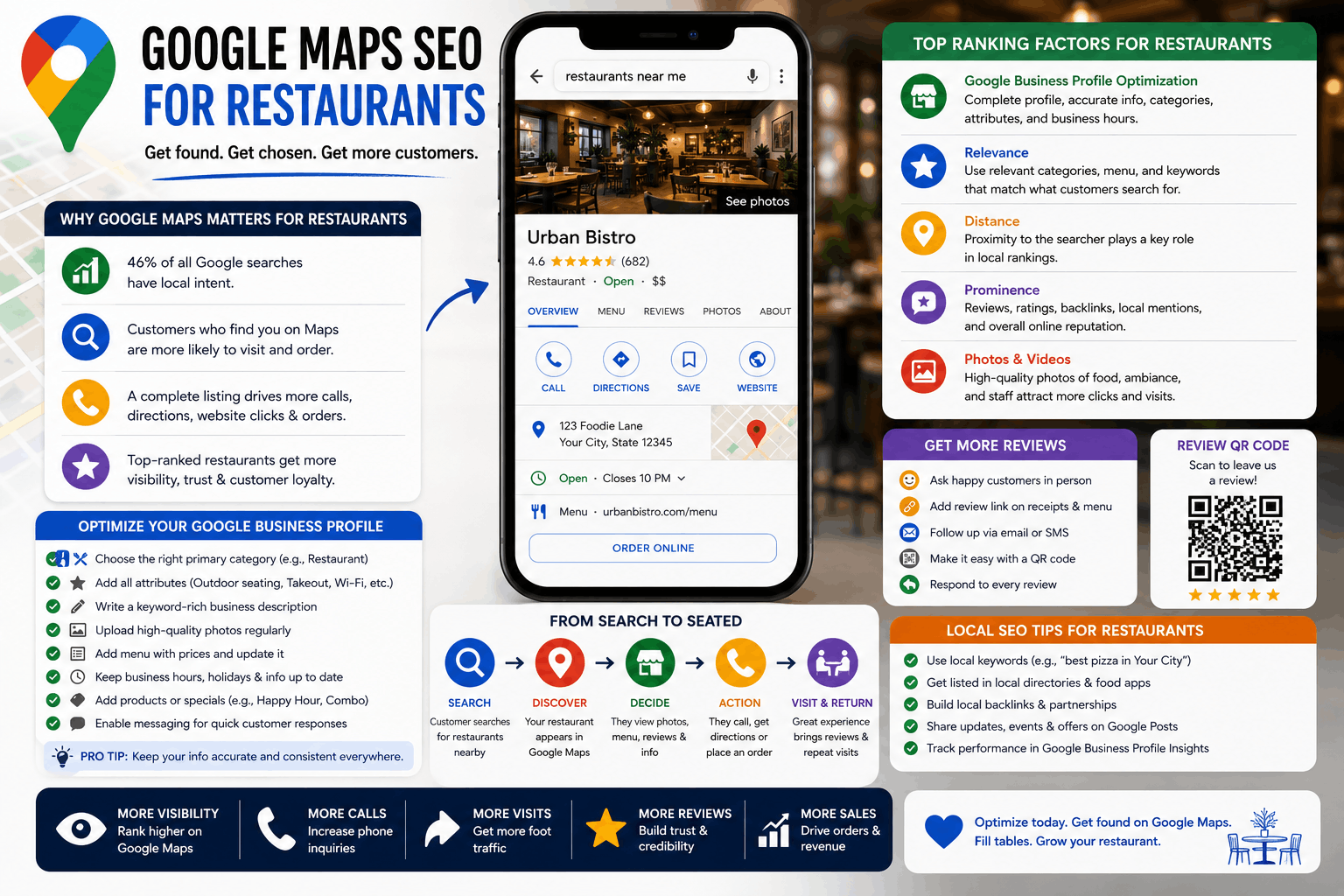
- Google Business Profile optimization
- Reviews
- Local authority
- Website SEO
- Customer engagement
Google Business Profile for Restaurants
Your Google Business Profile is often your restaurant’s first impression.
It displays:
- Ratings
- Reviews
- Menu
- Photos
- Reservation buttons
- Ordering options
- Hours
- Popular dishes
A strong profile can dramatically improve conversions.
Traditional SEO vs Restaurant Local SEO
| Traditional SEO | Restaurant Local SEO |
| Focuses on organic rankings | Focuses on Google Maps visibility |
| Broad keyword targeting | Local intent targeting |
| Website-centric | GBP + reviews + local signals |
| National/global traffic | Nearby diners |
| Long-term content focus | Immediate conversion focus |
Restaurants benefit most from local-intent optimization.
How Customers Search for Restaurants
Understanding diner behavior is critical.
Common Restaurant Searches
People commonly search:
- “restaurants near me”
- “best biryani near me”
- “late night food”
- “best café nearby”
- “vegan restaurant in Dallas”
- “family-friendly restaurants”
These are highly conversion-driven searches.
Mobile Search Trends
Most restaurant searches happen on smartphones.
Users often:
- Search while traveling
- Compare nearby options
- Call instantly
- Reserve tables
- Order online
Mobile optimization is essential.
Voice Search Behavior
Voice search continues growing rapidly.
Examples:
- “What’s the best pizza near me?”
- “Find restaurants open now.”
- “Best rooftop café nearby.”
Voice searches tend to be:
- Conversational
- Location-focused
- Immediate-intent driven
Google Business Profile Optimization for Restaurants
Choosing the Right Restaurant Categories
Your primary category strongly influences restaurant Google Maps ranking.
Common Categories
- Restaurant
- Indian Restaurant
- Pizza Restaurant
- Fast Food Restaurant
- Café
- Fine Dining Restaurant
Secondary Categories
- Delivery Restaurant
- Family Restaurant
- Vegetarian Restaurant
- Dessert Shop
Pro Tip
Choose the most accurate category possible.
Business Name Optimization
Use your actual restaurant name.
Common Mistake
“Best Pizza Restaurant NYC Cheap Pizza”
Keyword stuffing risks suspensions.
Menu Optimization
Your menu is one of the most important restaurant SEO assets.
Include:
- Accurate pricing
- Updated dishes
- Categories
- Descriptions
Why It Matters
Menus influence:
- Rankings
- Engagement
- Conversions
Reservation Links
Reduce booking friction.
Integrate:
- OpenTable
- Resy
- Reservation systems
Restaurants with easy booking options usually convert better.
Online Ordering Links
Delivery and takeaway links matter heavily.
Add:
- Direct ordering
- Delivery platforms
- Pickup options
Delivery Integrations
Cloud kitchens and fast-food businesses especially benefit from:
- Uber Eats
- DoorDash
- Swiggy
- Zomato integrations
Business Description
Describe:
- Cuisine
- Atmosphere
- Signature dishes
- Location relevance
Example
“ABC Bistro is a family-owned Italian restaurant in Austin serving wood-fired pizzas, handmade pasta, and seasonal desserts in a warm, modern setting.”
Service Attributes
Add:
- Outdoor seating
- Vegan options
- WiFi
- Delivery
- Wheelchair accessibility
- Family-friendly
These improve usability and conversions.
Photos and Food Photography
Food photography is massively important.
Restaurants with high-quality photos often receive:
- More clicks
- More reservations
- More calls
Include:
- Signature dishes
- Interiors
- Staff
- Dining ambiance
- Cocktails
- Desserts
Videos and Ambiance Content
Videos help customers experience:
- Atmosphere
- Music
- Food presentation
- Customer experience
Short authentic videos work extremely well.
Business Hours
Restaurant searches are highly time-sensitive.
Always keep hours accurate.
Holiday Hours
Update:
- Holiday schedules
- Festival hours
- Seasonal timings
Incorrect hours damage trust quickly.
Messaging
Enable messaging if your staff can respond promptly.
Many customers prefer quick questions before booking.
Q&A Optimization
Add FAQs like:
- “Do you accept reservations?”
- “Do you have vegan options?”
- “Is parking available?”
Google Posts
Post regularly:
- New dishes
- Seasonal menus
- Live music nights
- Events
- Promotions
Fresh activity improves engagement.
Event Promotions
Restaurants hosting:
- Live music
- Sports screenings
- Brunch events
- Festivals
should promote them heavily through GBP.
Seasonal Offers
Examples:
- Holiday menus
- Summer specials
- Valentine’s Day dinners
- Lunch combos
Google Maps Ranking Factors for Restaurants
Relevance
Google evaluates how closely your restaurant matches the search query.
Key factors:
- Categories
- Menu
- Reviews
- Keywords
- Website content
Distance
Nearby restaurants naturally gain advantages.
This is why hyperlocal optimization matters heavily.
Prominence
Prominence measures trust and authority.
Google evaluates:
- Reviews
- Brand mentions
- Links
- Popularity
- Engagement
Reviews
Restaurant Google reviews strongly impact:
- Rankings
- Click-through rates
- Reservations
Fresh reviews matter significantly.
Behavioral Signals
Google likely measures:
- Direction requests
- Calls
- Reservations
- Clicks
- Menu interactions
Website Authority
Strong restaurant websites support local rankings.
Local Citations
Consistent listings across:
- Yelp
- TripAdvisor
- Zomato
- OpenTable
improve trust signals.
Engagement Signals
Active restaurants with fresh photos, reviews, and posts often perform better.
Brand Searches
Popular branded searches reinforce authority.
How Restaurants Can Get More Google Reviews
Ethical Review Strategies
Never buy fake reviews.
Focus on authentic customer experiences.
QR Code Review Requests
Place QR codes:
- Tables
- Menus
- Bills
- Counter displays
This reduces friction dramatically.
Table-Top Review Prompts
Simple prompts work well.
Example
“Enjoyed your meal? Leave us a Google review.”
SMS Review Requests
Delivery and reservation systems can send review follow-ups automatically.
Post-Meal Follow-Ups
Restaurants with reservation systems can request reviews after dining experiences.
Delivery Review Requests
Delivery-focused restaurants should request reviews after successful deliveries.
Review Response Best Practices
Respond professionally to:
- Positive reviews
- Negative reviews
- Questions
Responses build trust.
Handling Negative Reviews
Stay calm and solution-focused.
Never argue publicly.
Restaurant Website SEO Optimization
Menu Pages
Create searchable menu pages instead of image-only PDFs.
This improves:
- SEO
- AI search visibility
- User experience
Location Pages
Multi-location restaurants need unique location pages.
Mobile Optimization
Most restaurant searches happen on mobile devices.
Ensure:
- Fast loading
- Easy navigation
- Click-to-call
- Reservation buttons
Click-to-Call Optimization
Phone calls still convert strongly for restaurants.
Reservation Optimization
Reduce friction in booking tables.
Local Landing Pages
Target:
- Neighborhoods
- Nearby districts
- Popular landmarks
Schema Markup
Recommended schema:
- Restaurant
- Menu
- FAQPage
- Review
- LocalBusiness
Internal Linking
Connect:
- Menus
- Events
- Blogs
- Location pages
Page Speed
Slow restaurant sites lose conversions rapidly.
Conversion Optimization
Strong CTAs matter:
- “Reserve Now”
- “Order Online”
- “Call Now”
Content Marketing for Restaurants
Food Blogs
Blog ideas:
- “Best Brunch Dishes”
- “Chef’s Seasonal Favorites”
- “How We Make Our Signature Pizza”
Seasonal Menus
Seasonal content improves freshness and engagement.
Chef Stories
Customers love authentic stories.
Feature:
- Chefs
- Ingredients
- Inspiration
- Local sourcing
Event Marketing
Promote:
- Wine tastings
- Live music
- Holiday events
- Special nights
Behind-the-Scenes Content
Kitchen preparation videos perform very well.
Video Marketing
Food videos are highly engaging.
Especially:
- Cooking processes
- Signature dishes
- Restaurant ambiance
Social Media Integration
Social activity can indirectly improve:
- Brand searches
- Engagement
- Awareness
AI Search Optimization
Optimize for:
- Conversational queries
- FAQs
- Menu clarity
- Local relevance
AI systems increasingly summarize restaurant information directly.
Local Citations & Backlinks for Restaurants
Restaurant Directories
List consistently on:
- Yelp
- TripAdvisor
- OpenTable
- Zomato
Food Blogs
Local food bloggers can generate:
- Traffic
- Mentions
- Backlinks
Local Business Listings
Consistency across directories matters heavily.
Influencer Mentions
Micro-influencers can significantly boost visibility.
Sponsorships
Sponsor:
- Community events
- Sports teams
- Festivals
Local Partnerships
Collaborate with:
- Breweries
- Cafés
- Event venues
Press Mentions
Local press coverage strengthens prominence.
Advanced Google Maps SEO Strategies for Restaurants
Multi-Location Restaurant SEO
Each restaurant location needs:
- Unique GBP
- Unique pages
- Unique reviews
- Unique photos
Hyperlocal SEO
Target nearby neighborhoods aggressively.
Competitor Analysis
Study:
- Reviews
- Photos
- Categories
- Menu optimization
- Popular dishes
Heat Map Ranking Tracking
Track visibility geographically.
Very useful for restaurant chains.
Behavioral Optimization
Encourage:
- Reservations
- Calls
- Direction requests
- Engagement
Entity SEO
Strengthen entity trust through:
- Consistent branding
- Mentions
- Reviews
- Structured data
AI Overviews Optimization
AI-generated restaurant recommendations increasingly rely on:
- Reviews
- Menus
- Sentiment
- Popular dishes
Voice Search Optimization
Optimize for:
- “best sushi near me”
- “restaurants open now”
- “late-night food nearby”
Reputation Management
Restaurant reputation directly impacts:
- Rankings
- Reservations
- Customer trust
Common Restaurant Local SEO Mistakes
Inconsistent NAP
Different business details weaken trust.
Duplicate GBP Listings
Duplicates confuse Google.
Poor Food Photography
Weak visuals drastically reduce conversions.
Ignoring Reviews
Restaurants should respond consistently.
Slow Websites
Slow-loading sites hurt reservations and orders.
Outdated Menus
Nothing frustrates customers faster than outdated menu information.
Missing Reservation Links
Extra friction reduces conversions.
Keyword Stuffing
Over-optimization can create trust and suspension risks.
Recommended Weekly Google Maps SEO Workflow for Restaurants
| Task | Frequency |
| Respond to reviews | Daily |
| Upload food photos | Weekly |
| Publish Google Posts | Weekly |
| Update seasonal offers | Weekly |
| Monitor rankings | Weekly |
| Request reviews | Daily |
| Review competitor activity | Monthly |
| Audit menu accuracy | Monthly |
Frequently Asked Questions
What is Google Maps SEO for restaurants?
It’s the process of improving restaurant visibility in Google Maps and local search results.
How do restaurants rank higher on Google Maps?
Optimize Google Business Profiles, improve reviews, upload fresh photos, and strengthen local SEO signals.
Are Google reviews important for restaurants?
Yes. Reviews strongly impact trust, rankings, and reservations.
What is the best category for restaurant GBP listings?
Use the most accurate category like Restaurant, Café, Pizza Restaurant, or Fine Dining Restaurant.
How important are food photos?
Extremely important. Photos heavily influence clicks and reservations.
Do restaurants need websites if they have GBP?
Yes. Websites improve authority, conversions, and SEO.
Does mobile optimization matter?
Absolutely. Most restaurant searches happen on smartphones.
How often should restaurants post on GBP?
At least weekly.
Can menus impact Google rankings?
Yes. Optimized menus improve relevance and engagement.
What are the biggest restaurant SEO mistakes?
Ignoring reviews, outdated menus, poor photos, and inconsistent information.
How important are local backlinks?
Very important for restaurant authority and prominence.
Can restaurants use influencer marketing for SEO?
Yes. Influencer mentions often generate traffic and local authority signals.
How does AI search affect restaurants?
AI increasingly summarizes reviews, menus, and popular dishes directly in search.
What is hyperlocal restaurant SEO?
Targeting nearby neighborhoods and local dining intent.
How long does restaurant local SEO take?
Most restaurants see improvements within 2–6 months depending on competition.