Why Your Calls Are Dropping Even Though Your Rankings Look Fine
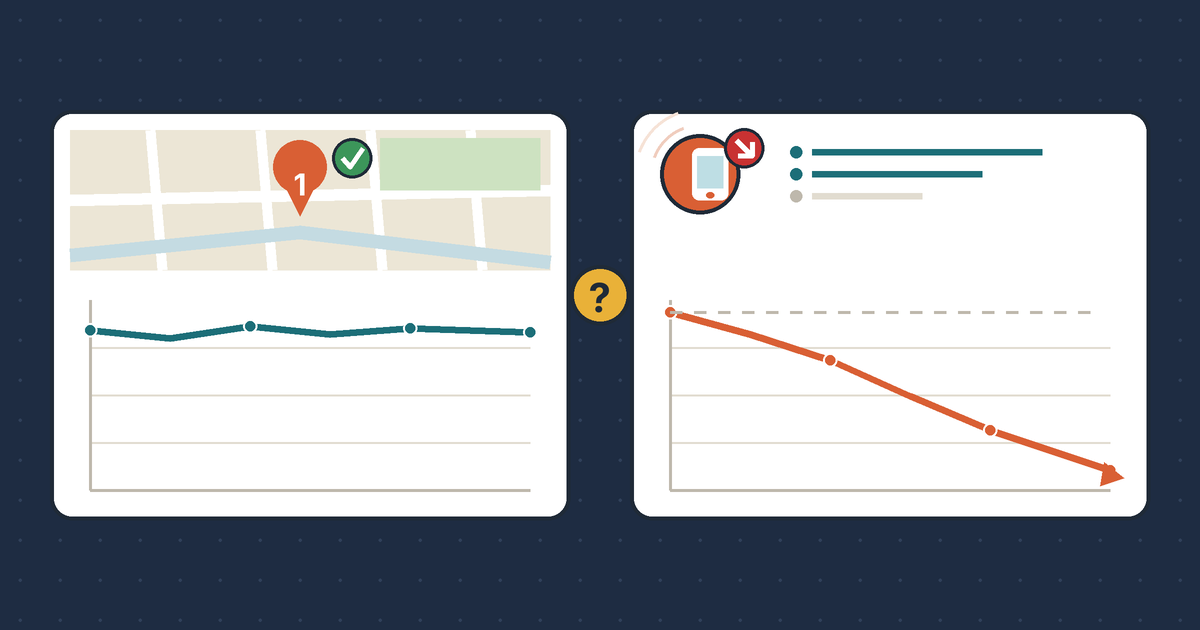

There’s a specific, disorienting pattern showing up across local businesses right now: the rank tracker says position two or three, unchanged for months, while the phone rings noticeably less than it used to. No dramatic ranking drop to point to. No obvious profile problem. Just a slow, real decline in calls that the reporting dashboard doesn’t explain at all.
This isn’t a measurement error, and it isn’t a sign that local SEO stopped working. It’s a specific, mechanical consequence of how local search results are changing, and understanding the actual mechanism matters more here than in most ranking-drop scenarios, because the usual troubleshooting playbook, check your profile, check your reviews, check your citations, won’t find anything wrong. The problem isn’t your position. It’s what’s actually happening around your position that a rank tracker was never built to see.
What a rank tracker is actually measuring, and what it isn’t
A traditional rank tracker checks where a business appears within a specific, known result format, typically the classic three-pack of map listings. That’s been a reliable proxy for visibility for a long time because that format was, for years, essentially the only way local results were presented.
That’s no longer reliably true. Google has been rolling out AI-generated local result formats, in some cases supplementing the traditional pack, in some cases replacing it for certain queries, that present information differently: sometimes surfacing a smaller number of businesses than a traditional three-pack would, sometimes changing where and how a call action is presented, sometimes generating a conversational summary rather than a straightforward list at all. Most rank tracking tools, built around detecting the traditional format, either don’t recognize these newer layouts as a distinct thing to measure, or simply can’t parse them the same way. The result is a genuine blind spot: your position in the format the tracker knows how to see can look completely stable while your actual visibility, in whatever format a real searcher is now seeing, has meaningfully changed.
The click-to-call problem specifically
Beyond format changes generally, there’s a more specific, targeted issue worth understanding: the prominence and even presence of the call action itself within local results appears to be shifting in some layouts. One industry analysis specifically tracking phone-call clicks across a sample of law firm profiles over a two-year period found a consistent pattern, call volume declining even when rank position held steady, and traced part of the cause to changes in how prominently, or whether at all, a call button appeared in certain result formats.
Whether this exact pattern applies identically to every industry and every query type isn’t something any single study can confirm, but the underlying mechanism is worth taking seriously regardless of the specific numbers: if a customer’s path from seeing your business to calling you requires an action that’s become less visible or been removed from a particular layout, calls will decline for reasons that have nothing to do with how well-optimized your business actually is.
Why this specifically fools normal reporting
The reason this gap is so disorienting is that it violates the assumption most local SEO reporting is built on: that rank position and real-world outcomes move together. For years, that assumption held up well enough that a stable rank position was a reasonable proxy for stable performance. This specific situation breaks that assumption without breaking anything else in a way that shows up on a standard report, which is exactly why businesses experiencing it describe it as confusing rather than alarming. Nothing looks broken. Something still is.
How to actually check whether this is happening to you
Manually search your own key terms, on an actual phone, the way a real customer would. Don’t rely on your rank tracker’s dashboard alone. Look at what result format actually appears for your most important queries right now, and note whether it matches the classic three-pack format or something newer and different.
Compare call volume trends against direction-request and website-click trends over the same period. If calls are declining while direction requests and website visits are holding steady or only modestly declining, that pattern points specifically toward a call-path problem, a missing or less visible call action, rather than a broader visibility decline that would usually affect every conversion type similarly.
Check whether your rank tracking tool has published anything about AI local pack detection. Some tools are actively working to detect and report on newer AI-generated formats, others aren’t yet, and knowing which category your current tool falls into tells you how much to trust a “nothing changed” reading from it right now.
Look at the actual result layout across a few different devices and, if possible, a few different real user accounts, since some of these AI-driven formats appear to roll out selectively rather than universally, meaning your own testing on one device may not reflect what a broader set of customers are actually seeing.
What to actually do about it
Don’t treat a stable rank position as proof that nothing needs attention. This is the core mindset shift this situation requires. A stable position is no longer sufficient evidence that visibility and conversion behavior are also stable, and reporting that treats rank as the headline metric risks missing exactly this kind of gap.
Diversify the paths a customer can use to actually reach you. If click-to-call visibility is genuinely becoming less reliable in some result formats, over-relying on phone calls as the primary measured conversion type is a real risk. Make sure booking links, click-to-message, and clear website contact paths are all genuinely functional and prominent, not backup options nobody actually uses, so that a change affecting one specific conversion path doesn’t disproportionately hurt your total lead flow.
Track calls, direction requests, and website actions together, not calls in isolation. A genuine overall visibility decline tends to show up across most or all of these metrics together. A decline concentrated specifically in calls, while other actions hold steady, is a more specific signal pointing toward exactly the call-path issue described here.
Keep watching, since this is an evolving, not settled, situation. Google’s local result formats are still actively changing, and today’s specific layout behavior isn’t guaranteed to be tomorrow’s. Building a habit of periodically checking actual result layouts manually, not just trusting a dashboard, is a more durable response than optimizing narrowly for whatever the layout happens to look like this month.
The multi-location angle: this can vary by market
For a multi-location business, it’s worth checking this across more than one market rather than assuming a finding in one city applies everywhere. AI-generated local result formats appear to be rolling out unevenly, by query type, by geography, by device, which means one location’s search results might already reflect a newer format while another location’s don’t yet. A multi-location business that only checks its headquarters market risks missing that some individual locations are already experiencing this call-path disruption while others aren’t, which is exactly the kind of location-level blind spot this content cluster has returned to repeatedly for other issues.
Key Takeaways
- Stable rank position no longer reliably implies stable real-world visibility or conversion behavior. Rank trackers built around a classic result format can miss newer AI-generated local layouts entirely.
- Some reported data points to call button visibility specifically changing or disappearing in certain newer result formats, which can reduce call volume independent of actual ranking or optimization quality.
- A decline concentrated specifically in calls, while direction requests and website visits hold steadier, is a more specific signal of a call-path issue than a broad visibility problem.
- Manually checking actual result layouts on a real device, rather than relying solely on a tracking dashboard, is the most direct way to confirm whether this is happening to you.
- Diversifying conversion paths, booking links, messaging, clear website contact options, reduces the risk that a change affecting one specific action, like call button prominence, disproportionately hurts total lead flow.
- This situation can vary by market for multi-location businesses, so checking more than one location’s actual search results is worth doing rather than assuming a single market’s experience applies network-wide.
Frequently Asked Questions
Why would my calls decline if my local rankings haven’t changed?
Rank trackers typically measure position within a specific, traditional result format. Newer AI-generated local result layouts can present businesses differently, sometimes with reduced or missing call-action visibility, without necessarily changing your measured rank position, which creates a real gap between what your tracker reports and what’s actually happening to call volume.
Is this a sign my Google Business Profile has a problem?
Not necessarily. This specific pattern, stable rankings with declining calls, points more toward a change in how local results are presented and how prominently a call action appears, rather than a problem with your profile’s completeness or accuracy.
How can I tell if this is actually happening to my business?
Manually search your key terms on an actual phone and look at the real result layout, then compare your call volume trend against your direction-request and website-click trends over the same period. A decline concentrated specifically in calls is a more specific signal of this issue than a broad decline across every metric.
Should I stop relying on phone calls as my main conversion metric?
Not entirely, but diversifying the conversion paths available, booking links, click-to-message, clear website contact options, reduces the risk that a change affecting call visibility specifically has an outsized impact on your total measured leads.
Does this affect every industry and every local business equally?
The specific data available so far is limited to particular studies and industries, so it’s not safe to assume identical impact everywhere. The underlying mechanism, newer result formats potentially changing call visibility, is worth checking for regardless of industry, since it’s a layout issue rather than something specific to one business category.
Is this a permanent change or something that might revert?
It’s genuinely uncertain. Local result formats are still actively evolving, which is part of why this is worth monitoring on an ongoing basis rather than treating today’s specific layout behavior as a fixed, permanent state to optimize around indefinitely.