What Google’s Ask Maps Feature Means for Local Business Visibility
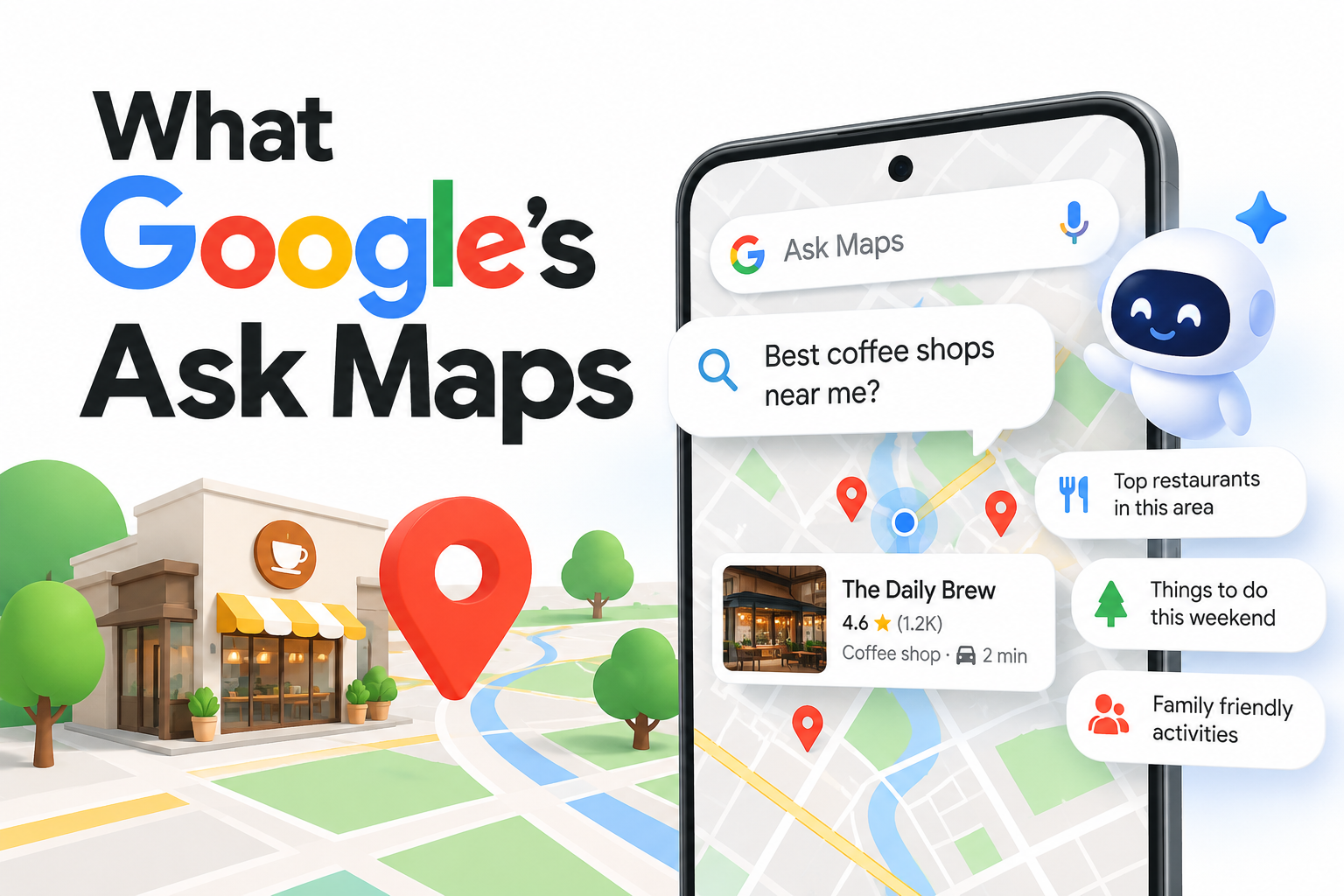

Google Maps used to work like a directory: type a category, get a scrollable list, compare a handful of pins yourself. Ask Maps, the Gemini-powered feature Google launched in March 2026, changes that experience directly. Instead of typing “coffee shop” and scrolling, a user can now ask something like “where can I get a quiet coffee with good wifi near the station” and get a short, direct, conversational answer, often just three to five recommendations, rather than a full list to browse.
That shift from list to shortlist is the part worth paying close attention to. A scrollable list gave every reasonably decent business a real chance of being seen, even sitting at position eight or nine. A shortlist of three to five doesn’t work that way. Being good enough to rank respectably in the old list-based experience doesn’t guarantee a spot on the new, much shorter one, and this article is about exactly what does.
What Ask Maps actually is
Ask Maps is a conversational search layer built into Google Maps, powered by Google’s Gemini AI, currently rolling out on Android and iOS in the US and India, with broader availability expected over time. Instead of matching a short keyword query against listings the way traditional Maps search does, Ask Maps interprets a natural-language question, drawing on business profiles, reviews, photos, and attributes to generate a direct, personalized answer, often incorporating a user’s own search and visit history to shape which recommendations actually surface.
The practical difference for a searcher is significant. A query like “tires” returns a straightforward list of tire shops nearby. A query phrased more like an actual thought, “where can I get new tires without waiting all afternoon,” asks Ask Maps to reason about wait time, service speed, and probably review sentiment about how efficiently a shop operates, not just proximity and category match. Businesses that have the right underlying evidence, specific attributes, detailed reviews mentioning exactly this kind of thing, can surface for a question like this even without ever explicitly targeting it. Businesses that don’t have that evidence available simply won’t come up, regardless of how solid their basic listing is.
Why this specifically raises the competitive bar
In the old, list-based Maps experience, showing up somewhere on the list was often good enough to get considered, since a motivated searcher would scroll and compare. Ask Maps compresses that list down to a handful of conversational recommendations, and Google has been explicit that these are presented as the best options for that specific question, not a full directory. That means the businesses now competing for visibility aren’t just competing to rank reasonably well. They’re competing for one of a genuinely small number of slots, for each specific, sometimes quite narrow, way a customer might phrase their need.
This is a meaningfully different competitive dynamic than most local SEO advice was built around, and it’s worth taking seriously specifically because it’s already live, not a future possibility to plan around eventually.
What actually determines whether a business makes the shortlist
Specific, complete business attributes. Ask Maps needs to match a business against specific qualities embedded in a conversational question, quiet, family-friendly, accepts walk-ins, wheelchair accessible, and it can only do that if those attributes are actually filled in on the Google Business Profile. A business with a technically complete but generically filled-in profile gives Ask Maps very little specific material to match against a detailed, natural-language question.
Reviews that mention specific, concrete detail, not just sentiment. Since Ask Maps appears to draw heavily on review content to answer detailed, qualitative questions, a review that says “quick service, in and out in fifteen minutes” gives it something concrete to match against a question about wait times. A review that just says “great place, five stars” doesn’t carry the same specific evidentiary weight for a conversational, attribute-driven query.
Current, genuine photos. Photo currency and relevance appear to factor into how confidently a business gets recommended, likely because visual evidence helps corroborate claims a business or its reviews make. Stale, outdated, or sparse photos are a weaker signal than a recent, representative set.
Consistent, accurate listing information generally. This is the same foundational discipline this content cluster has emphasized repeatedly, and it matters here specifically because Ask Maps is synthesizing an answer from whatever evidence it can confidently piece together. Inconsistent or incomplete information reduces that confidence exactly at the moment a business is competing for one of a small number of shortlist slots.
A frictionless path once a business does get recommended. Ask Maps functions increasingly like a concierge, someone asks, gets an answer, and acts on it quickly. A business that gets recommended but has an outdated phone number, unclear hours, or a broken booking link loses much of the advantage of having made the shortlist in the first place.
A practical readiness check
- Open your own Google Business Profile and check whether every relevant attribute for your category is actually filled in, not just the obvious ones.
- Read through your ten most recent reviews and note how many contain specific, concrete detail versus generic praise. If most are generic, your review-request process may need to prompt for more specific feedback.
- Check your photo library for recency and relevance. Photos older than a year, or ones that don’t clearly represent the current business, are worth refreshing.
- Try asking Google Maps a few natural, detailed questions relevant to your business category and see whether you appear, and if a competitor appears instead, note what their profile and reviews emphasize that yours might not.
- Confirm that your hours, phone number, and any booking or contact links are current and functional, since a shortlist appearance is wasted if the follow-through has friction in it.
The multi-location version of this problem
For a business with multiple locations, Ask Maps readiness has to be checked location by location, the same way this content cluster has emphasized for nearly every other local search dynamic. A shortlist recommendation is generated in response to a specific, geographically anchored question, and the evidence Ask Maps draws on, attributes, reviews, photos, is specific to each individual profile, not inherited from the strongest location in the network.
This means a brand can have one flagship location with rich, detailed reviews and complete attributes that reliably surfaces in Ask Maps recommendations, while a dozen other locations, run with less individual attention, quietly never come up at all for the exact same kind of conversational query, simply because their underlying profile data doesn’t give Ask Maps enough specific material to work with. Running the readiness check above across a sample of locations, not just the one someone happens to think of first, is the only way to know whether this gap actually exists across a network.
What not to overreact to
Ask Maps is still in a relatively early rollout, currently available in specific markets on specific platforms, and Google hasn’t published full detail on exactly how ranking and shortlist inclusion work, or whether that might change as the feature matures. This is worth acting on now, since the underlying readiness work, better attributes, more specific reviews, current photos, benefits a business regardless of exactly how Ask Maps evolves, but it’s not worth building an entirely new strategy narrowly around today’s specific behavior of one feature that’s likely to keep changing.
Key Takeaways
- Ask Maps is a real, currently rolling out Google Maps feature that answers natural-language questions with a short, conversational shortlist, typically three to five recommendations, rather than a scrollable list of results.
- This raises the competitive bar meaningfully, since businesses are now competing for a small number of shortlist slots for specific, detailed questions, not just a respectable position in a longer list.
- Specific, complete attributes, reviews with concrete detail, current photos, and consistent listing information all appear to influence whether a business gets included in an Ask Maps recommendation.
- A frictionless follow-through, current hours, working contact and booking links, matters once a business does make the shortlist, since the value of inclusion is lost if the next step has friction in it.
- For multi-location businesses, this readiness needs checking location by location. A strong flagship location doesn’t guarantee the rest of the network is equally ready to surface in Ask Maps recommendations.
- Ask Maps is still early in rollout and likely to evolve. The underlying readiness work is worth doing regardless, without over-indexing a whole strategy on the feature’s current specific behavior.
Frequently Asked Questions
What is Ask Maps?
Ask Maps is a conversational search feature inside Google Maps, powered by Google’s Gemini AI, launched in March 2026. It lets users ask natural-language questions about places rather than typing short keywords, and returns a short, direct set of recommendations rather than a full scrollable list.
Is Ask Maps available everywhere?
As of its initial rollout, Ask Maps is available on Android and iOS in the US and India, with broader availability expected to expand over time.
How is Ask Maps different from a normal Google Maps search?
A normal Maps search matches a keyword or category against nearby listings and returns a list to browse. Ask Maps interprets a more detailed, natural-language question and generates a short, conversational answer, often drawing on review content and specific business attributes to match nuanced requests.
What can I do to improve my chances of appearing in Ask Maps recommendations?
Make sure your Google Business Profile attributes are specifically and completely filled in, encourage reviews that mention concrete detail rather than generic praise, keep photos current, and make sure your listing information is accurate and consistent, since Ask Maps draws on all of this to generate its recommendations.
Does a strong position in traditional Google Maps rankings guarantee inclusion in Ask Maps?
Not necessarily. Ask Maps appears to weigh specific attribute and review evidence relevant to the exact question asked, which means a business that ranks reasonably well in general search may still not surface for a specific, detailed conversational query if its profile lacks the specific evidence that query calls for.
How should multi-location businesses approach Ask Maps readiness?
Check readiness location by location rather than assuming brand-wide strength applies everywhere. Attribute completeness, review specificity, and photo currency are all evaluated per profile, so individual locations can vary significantly in how likely they are to surface in Ask Maps recommendations.