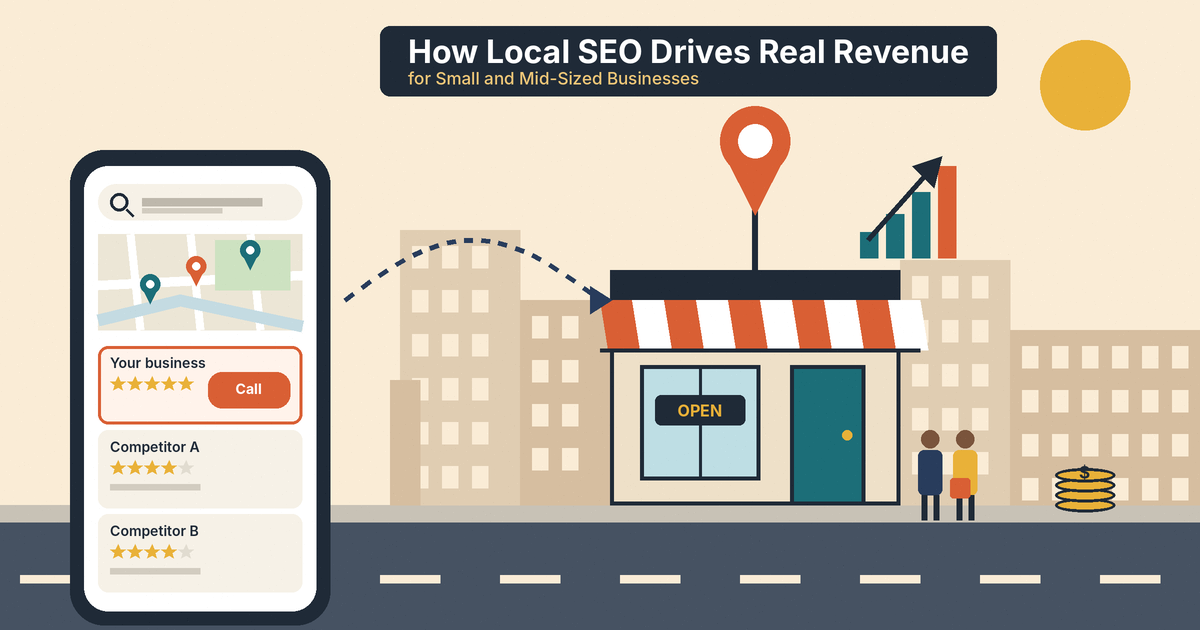
How Local SEO Drives Real Revenue for Small and Mid-Sized Businesses

What is local SEO and why does it matter for business growth?
Local SEO is the practice of improving how a business appears when people search for products or services in a particular area. It helps a business show up in relevant local organic results, in Google Maps and in the local results Google displays for eligible queries.
Google describes the experience this way: when a customer searches for a business or place near their location, they find local results on Google Maps and Search, and Google tries to show the kind of nearby business they would like to visit. Local SEO covers the work that makes your business a good match:
- Local keyword targeting: pairing each service with the places you serve, such as “accountant in Austin”
- Google Business Profile optimization: complete, accurate details, suitable categories, services, photos and hours
- Business information accuracy: the same name, address, phone number and hours everywhere customers might look
- Reviews and reputation: genuine customer feedback and thoughtful owner replies
- Location and service-area pages: useful pages for places you genuinely serve
- Local authority and relevant links: real mentions and links from local organizations and publications
- Mobile-friendly website experiences: pages that load quickly and make contacting you easy
Local SEO matters most for businesses that depend on customers in a defined geographic market, such as plumbers, dentists, salons, restaurants and retailers. A national brand can win customers from anywhere. A neighborhood business wins by being the clear, trusted choice nearby.
How local SEO turns search demand into paying customers
Every sale from local search follows a journey. A ranking improvement helps at one stage only, so it does not automatically become a sale. Revenue appears when the business performs well at every stage.
| Stage | What happens | How to improve it | What to watch |
| 1. Discovery | A potential customer searches for a local product or service | Target the services and places customers actually search for | Search terms and impressions |
| 2. Visibility | The business appears in suitable local results | Accurate profile, right categories, relevant pages, reputation | Profile views, local visibility |
| 3. Evaluation | The customer compares reviews, services, prices, location and credibility | Real photos, recent reviews with replies, clear services and pricing guidance | Review volume and ratings, profile actions |
| 4. Contact | The customer calls, requests a quote, books or visits | Click-to-call, accurate hours, booking links, simple forms | Calls, direction requests, enquiries |
| 5. Conversion | The business wins the customer and earns revenue | Fast response, clear quotes, good sales follow-up | Lead-to-customer rate, revenue |
| 6. Retention | A good experience brings repeat purchases and referrals | Reliable service, follow-up, review requests | Repeat purchase rate, referrals |
A business can be strong at stages 1 and 2 and still lose money at stage 4 or 5, for example by missing calls, quoting slowly or sending visitors to a confusing page. That is why the most useful local SEO work spans the whole journey, from being found to being chosen.
Six ways local SEO drives revenue for small and mid-sized businesses
Local SEO supports revenue in six main ways. None is automatic, and each depends on the quality of the business behind the listing.
1. It attracts customers with strong purchase intent
Many local searches describe a specific need: “emergency plumber near me,” “dentist accepting new patients,” “accountant in Austin.” The searcher is not browsing. They are choosing someone to call, book or visit, often soon.
Relevant local visibility can therefore bring more qualified prospects than broad, unrelated website traffic, such as visitors from another country reading a general article. A blog post might attract thousands of readers who will never become customers. A well-matched local result puts you in front of people in your service area who need what you do. Target the service and the place together, for example “emergency plumber in Dallas,” rather than chasing “near me” phrases.
2. It generates more calls, bookings and enquiries
Intent only becomes revenue when contacting you is easy. Friction reduces enquiries, and small fixes can remove it:
- Accurate opening hours and holiday hours, so people do not call a closed phone
- A tappable phone number and a visible booking or quote link
- Clear service descriptions that say what you do and where
- Landing pages that match the search, instead of a generic homepage
- Short enquiry forms that work well on a phone
You can measure each action: profile calls, website clicks, direction requests, bookings, messages, form submissions and tracked phone calls.
3. It builds trust through reviews and business information
Customers compare before they choose. Genuine reviews, owner replies, accurate contact details, real photos and consistent service information all help them decide. Google notes that reviews show next to your Business Profile in Maps and Search, and that replying shows customers their feedback matters.
Reviews can influence decisions, but they do not guarantee higher rankings or sales. They must also be real: Google says offering incentives such as free or discounted goods or services in exchange for reviews is strictly prohibited. Ask every customer, make it easy, and reply to all feedback professionally.
4. It improves visibility in Google Maps and local results
Google says local results are mainly based on relevance, distance and prominence. Relevance is how well your profile matches the search, distance is how far you are from the searcher, and prominence reflects how well-known you are, including factors such as links from websites and review count.
You influence relevance and prominence with appropriate categories, complete information, useful website content and a genuine reputation. You cannot change distance, and Google states that there is no way to request or pay for a better local ranking. No honest provider can promise first-place positions or guaranteed Maps placement.
5. It can reduce dependence on paid advertising
Organic local visibility can keep creating discovery opportunities without a charge for each individual click. That can make marketing spend steadier over time, especially when your presence is strong in the searches that matter.
Be realistic, though. Organic leads are not free. Local SEO needs ongoing investment, maintenance and time, and results are slower to build than paid campaigns. Many businesses use both: paid ads for speed and control, local SEO for compounding presence. Paid advertising can complement local SEO rather than replace it.
6. It supports repeat business and long-term customer value
Accurate listings, helpful content, strong service and a credible online reputation can all support repeat purchases, referrals and retention. A customer who found you through a search and had a good experience may return, recommend you or leave a review that helps the next customer.
Keep the roles separate. Local discovery brings people in the door. Keeping them depends on the service experience, communication and follow-up that happen afterward.
Real-world examples of local SEO driving business revenue
Important: The four scenarios below are hypothetical illustrations. They are not real client results, and they contain no invented percentages, revenue figures or case-study outcomes. Their purpose is to show how local SEO work connects to measurable business results. For your own business, replace each assumption with your analytics, call records and sales data.
Example 1: A plumbing company (hypothetical)
- Challenge: The company has a good website but few calls from its service area, and its Business Profile lists only a general plumbing category.
- Local SEO action: Set the most specific primary category, list services such as drain clearing and water heater repair, confirm accurate service areas and hours, add a page for emergency repairs in each area it truly serves, and ask finished customers for reviews.
- Customer behavior targeted: Urgent searches such as “emergency plumber in Dallas” and “water heater repair in Plano.”
- Metrics to measure: Profile calls, tracked phone calls, quote requests, jobs booked, average job value.
- Path to revenue: More qualified calls lead to more booked jobs. Revenue depends on how many calls are answered, how many become jobs and the average job value.
Example 2: A dental clinic (hypothetical)
- Challenge: The clinic is new in town and patients choose better-known practices.
- Local SEO action: Verify and complete the profile, show accurate hours and accepted services, add real photos of the clinic and team, build service pages for treatments, request genuine reviews and make online booking easy.
- Customer behavior targeted: Searches such as “dentist accepting new patients” and “emergency dentist in Plano.”
- Metrics to measure: Appointment requests, booking-link clicks, new-patient bookings, show-up rate and the value of treatments completed.
- Path to revenue: New-patient appointments turn into treatment revenue, and satisfied patients may return and recommend the clinic.
Example 3: A local restaurant (hypothetical)
- Challenge: Tourists and nearby residents choose other places because the profile shows outdated hours and no menu.
- Local SEO action: Correct regular and holiday hours, add the menu, current photos and relevant attributes, answer customer questions, reply to reviews and keep the phone number accurate.
- Customer behavior targeted: Immediate searches such as “Italian restaurant open now” and “family restaurant in Leeds.”
- Metrics to measure: Direction requests, calls for reservations, website clicks to the menu, covers and average spend per table.
- Path to revenue: More people who find an accurate, open listing arrive and spend, and repeat visits grow with a good experience.
Example 4: A multi-location service business (hypothetical)
- Challenge: Five locations share one generic page, and some profiles have outdated details or unanswered reviews.
- Local SEO action: Give each real location its own accurate profile and a genuinely useful location page with local details, keep names and categories consistent, and review each location’s performance monthly.
- Customer behavior targeted: Location-specific searches such as “HVAC repair in Raleigh” and “HVAC repair in Durham.”
- Metrics to measure: Calls, direction requests and enquiries by location, lead-to-customer rate and revenue by location.
- Path to revenue: The business can see which locations convert and invest more where the numbers justify it.
How to replace these assumptions with your own data
- Choose the actions that matter, such as calls, bookings or quote requests.
- Record each one by source, using your profile’s performance report, call tracking and your booking or CRM system.
- Track how many of those leads become customers, and how much each is worth.
- Compare periods, and change one thing at a time where you can.
When you can follow a lead from the search to the sale, you stop guessing and start measuring.
How to calculate local SEO ROI
Local SEO ROI compares the profit local search brings in with what you spend to earn it. Three definitions keep the numbers honest:
- Revenue from local SEO: revenue from customers acquired through measurable local organic search and Business Profile discovery, using an attribution method you can defend.
- Profit contribution: attributable revenue multiplied by the relevant contribution margin, before deducting the local SEO investment.
- Local SEO ROI: the return on that investment, calculated as below.
ROI (%) = [(Attributable profit contribution − Local SEO investment) ÷ Local SEO investment] × 100
Revenue and profit are not interchangeable. A job that brings in $500 might leave $200 after materials and labor, and ROI built on revenue alone overstates the result. Attribution is also imperfect, since a customer may see your profile, visit your website, ask a friend and then call.
Hypothetical worked example
These figures are assumptions for illustration only, not promised or typical results.
| Step | Assumption or calculation | Result |
| Monthly local SEO investment | Assumed | $1,000 |
| Attributable monthly revenue | Assumed | $5,000 |
| Contribution margin | Assumed | 40% |
| Attributable profit contribution | $5,000 × 40% | $2,000 |
| Net contribution after SEO investment | $2,000 − $1,000 | $1,000 |
| Illustrative ROI | ($2,000 − $1,000) ÷ $1,000 × 100 | 100% |
The calculation leaves out other costs, such as staff time spent on enquiries, unless you include them. Add any costs you think belong in the investment to get a more cautious figure.
Practical attribution methods
- Call tracking or a simple call log that records how each caller found you
- “How did you hear about us?” on forms, bookings and at the counter
- A source field in your CRM or booking system for every new lead
- Tagged website links on your Business Profile, so visits from it can be separated in analytics
- Business Profile performance data for calls, website clicks and direction requests
No method is perfect, and combining two or three gives a clearer picture. Look for the trend over several months instead of treating one month as proof.
The local SEO metrics that matter most for revenue
Track the chain from visibility to revenue, not one number. Google says Business Profile performance data is available only for verified profiles, and that only the metrics that apply to your business appear.
| Metric | What it measures | Why it matters | How to track it |
| Relevant local search impressions | How often you appear for searches that matter | Shows whether you are visible for the right queries | Business Profile views and search terms, Search Console |
| Organic website clicks | Visits from search to your site | Shows whether searchers choose your pages | Search Console and analytics |
| Business Profile calls and website clicks | Taps on the call button and website link | Direct contact and interest signals | Business Profile performance report |
| Direction requests (where relevant) | People asking for directions to you | A sign of intent to visit | Business Profile performance report |
| Qualified enquiries | Enquiries that fit what you sell and where you serve | Separates real prospects from noise | Call log, forms, CRM |
| Appointment and booking volume | Bookings made | Closest signal to revenue before the sale | Booking system, Business Profile bookings where available |
| Lead-to-customer conversion rate | Share of leads that become customers | Shows sales performance, not just marketing | CRM or sales records |
| Average transaction value | Typical revenue per customer | Turns lead counts into money | Sales or accounting records |
| Revenue attributed to local search | Sales traced to local discovery | The headline business result | CRM source fields, call tracking |
| Customer acquisition cost | Cost to win one customer from local search | Tests whether the channel is worth the spend | Local SEO cost divided by new customers |
| Repeat purchase rate (where applicable) | Share of customers who buy again | Shows long-term value | Customer records |
A Business Profile interaction does not prove that a sale happened. A call button click is not a completed call, and a direction request is not a visit. Connect the data you have with call tracking, CRM records, booking systems or sales data wherever practical, so each metric points to the next. Google also notes that profile views are counted as unique visitors, so they can be lower than other counts you may see.
How to build a local SEO strategy that supports revenue growth
This checklist focuses on actions that lead to enquiries and sales. Items 2, 7 and 9 are foundational for almost every local business. The rest depend on your business model, market and resources.
- Identify high-intent local keywords that match what you actually sell. Pair each service with the places you serve, such as “roof repair in Tampa,” and prioritize the searches that signal a need to buy.
- Optimize your Google Business Profile with accurate details and the most specific primary category, then add secondary categories only where they genuinely apply. (Foundational.)
- Develop useful service and location pages where they meet real customer needs. Build one only when you can say something specific about the service or area.
- Improve mobile usability and conversion paths. Fast pages, tappable phone numbers and short forms remove steps between a visitor and a call.
- Publish clear service descriptions, pricing guidance and helpful FAQs where appropriate. Honest price ranges and the factors that affect them filter for serious customers.
- Encourage genuine reviews. Ask real customers, share your Google review link or QR code, and reply to feedback. Do not buy reviews or offer incentives, which Google prohibits.
- Keep opening hours, contact details and service areas accurate across your profile, website and listings. (Foundational.)
- Make calls, bookings and enquiries easy. Put the main action in the first screen on mobile, and answer or return calls fast.
- Track qualified leads and connect them to sales. Use call tracking, a source field in your CRM and your profile’s performance report. (Foundational.)
- Review results regularly and prioritize changes by business impact, not by what is easiest to measure.
A small business with a tight budget can start with items 2, 7, 6 and 9. A multi-location business should add consistency and reporting across every location.
Common local SEO mistakes that prevent revenue growth
| Mistake | Why it costs you | What to do instead |
| Focusing on rankings instead of qualified leads | A top position that brings no calls does not pay | Track enquiries, bookings and sales alongside visibility |
| Targeting broad keywords that attract irrelevant traffic | Visitors who live elsewhere or want something else never buy | Pair services with the places you actually serve |
| Using incomplete or inaccurate business information | Customers call the wrong number or arrive when you are closed, and Google says inaccurate information can keep a profile from appearing for relevant searches | Audit hours, address, phone, categories and services monthly |
| Creating thin, repetitive location pages | They add little for visitors and risk Google’s scaled content abuse policy | Build a page only where you have something real to say |
| Ignoring reviews and customer questions | Unanswered feedback looks careless and wastes a trust signal | Reply to every review and answer common questions |
| Sending search visitors to generic or irrelevant pages | People who do not find what they searched for leave | Link each service and location to a matching page |
| Failing to track phone calls and completed sales | You cannot prove what works or fix what does not | Use call tracking and source fields |
| Expecting immediate results | Local visibility and reputation take time to build | Set a review period of several months and track trends |
| Treating profile optimization as a one-time task | Hours change, locations move and reviews keep arriving | Schedule a monthly profile and review check |
Is local SEO worth it for small and mid-sized businesses?
It can be, when the economics work. Local SEO tends to make most sense for a business with strong local demand and a clear way to turn enquiries into paying customers. Weigh these factors:
- Local search demand: Are people in your area searching for what you sell?
- Average customer value: A higher-value sale can justify more effort per lead.
- Profit margins: Margin decides how much of each sale can fund marketing.
- Competition: Crowded markets may need more time, effort and a distinct offer.
- Geographic service area: The tighter the area, the more local intent matters.
- Sales conversion rate: Strong follow-up makes every lead worth more.
- Time and budget: Local SEO is ongoing work, not a one-time purchase.
- Ability to measure: If you cannot track leads to revenue, you cannot tell if it is working.
Results vary by market and execution, and no one can promise a specific outcome. The sensible test is to estimate your average customer value, margin and conversion rate, then ask how many extra customers per month would pay for the effort.
How LocalChampion can help businesses turn local visibility into growth
Turning local visibility into customers takes steady, structured work: an accurate profile, the right categories, useful local content, a healthy reputation and regular measurement. Many owners know what to do but lack the time to keep doing it across every month and, for multi-location businesses, every location.
LocalChampion focuses on that work. Its Google Business Profile optimization service is built around a structured approach to profile accuracy, relevant categories, local content, reputation management and performance measurement. According to the LocalChampion website, its platform tracks rankings, reviews and local search performance, and shows Business Profile metrics such as views, calls and direction requests in one place, for one location or many.
What this can do for you is practical: it can make gaps easier to spot, keep your profile current and show you which actions are turning into enquiries. What it cannot do is guarantee Google’s decisions, rankings or revenue. Results still depend on your market, competition, service quality and how well you convert enquiries.
If you want to talk through your own local visibility goals, you can explore LocalChampion’s Google Business Profile optimization service or contact the team to discuss what would help your business most.
Conclusion: measure local SEO by business outcomes, not just rankings
Local SEO connects customer intent with discovery, trust, qualified enquiries and sales. It works when a business is visible for the right local searches, gives people good reasons to trust it, makes contacting it easy, and then delivers on the promise.
The habit that separates businesses that profit from local SEO from those that merely appear is measurement. Track calls, bookings, qualified leads, attributable revenue and profit contribution, not just keyword positions or impressions. Connect your profile data with call tracking, CRM records and sales data, and review it regularly.
To start building a local presence that can support measurable growth, take a look at LocalChampion’s Google Business Profile optimization service.
Frequently asked questions
How does local SEO help small businesses increase revenue?
It helps nearby customers find, trust and contact a business at the moment they need it. That can lead to more calls, bookings and enquiries, and revenue when enough of them become paying customers. The outcome depends on competition, demand, implementation quality, pricing, service quality and how well the business converts leads.
How long does local SEO take to generate leads?
There is no fixed timeline, and Google does not publish one. Fixing inaccurate hours or a missing category can matter quickly once Google processes the changes, while building reviews, content and prominence usually takes months. Competition, your starting point and the work you put in all affect speed, so judge results over a sustained period, not a few weeks.
How can a business measure local SEO ROI?
Compare the profit contribution of customers attributed to local search with your local SEO investment: ROI = [(attributable profit contribution − investment) ÷ investment] × 100. Attribute revenue with call tracking, source questions and CRM data, use profit rather than revenue, and treat the result as an estimate because attribution is imperfect.
Is Google Business Profile optimization enough to generate local leads?
It is a strong foundation, but usually not enough on its own. Customers also look at your website, reviews, pricing and how easily they can contact you. A complete profile helps you appear, while a good website, genuine reviews and fast follow-up help you win the customer. Results still vary with competition and demand.
Is local SEO more cost-effective than paid advertising?
It depends. Local SEO can keep producing discovery opportunities without a charge for each click, but it needs ongoing investment, takes time and has no guaranteed outcome. Paid advertising is faster and more controllable but stops when the budget stops. Compare each channel by cost per customer and profit, using your own data, and consider using both.