How to Respond to Negative Google Reviews
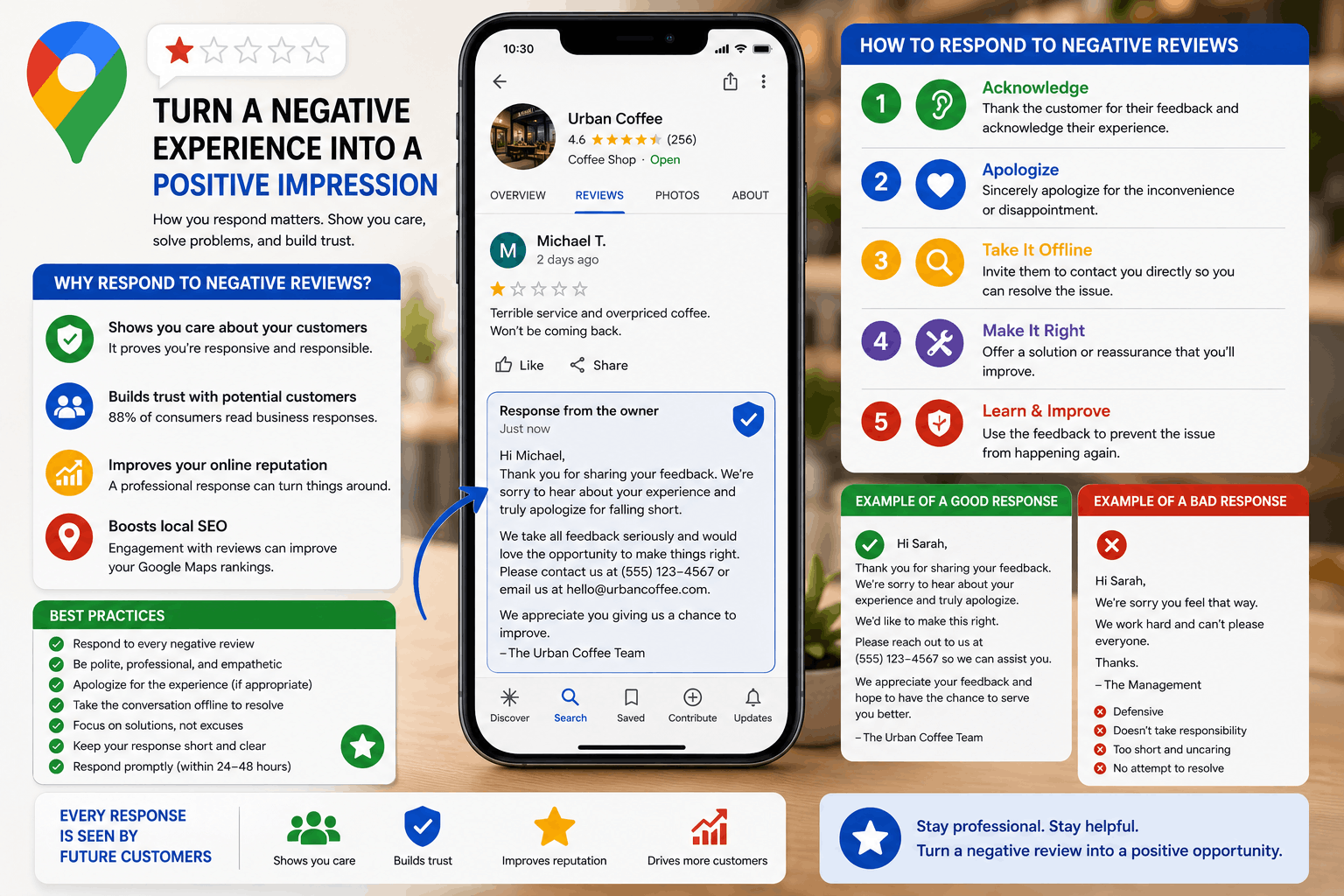

Introduction
Negative Google reviews can feel frustrating, unfair, and sometimes even personal.
For many business owners, a bad review feels like a public attack on years of hard work.
But here’s the reality:
Negative reviews are part of doing business online.
Even the best businesses in the world receive complaints occasionally.
What actually matters is how you respond.
A thoughtful, professional response can:
- Protect your reputation
- Build customer trust
- Improve conversions
- Demonstrate professionalism
- Reduce customer churn
- Strengthen your brand image
In many cases, potential customers pay more attention to review responses than the review itself.
Why?
Because responses reveal:
- How your business handles problems
- Whether you care about customers
- Your professionalism under pressure
- Your communication style
A calm, empathetic response can actually turn a negative review into a trust-building opportunity.
And from a local SEO perspective, review activity and engagement also influence Google Business Profile visibility and Google Maps rankings.
This guide explains exactly how to respond to negative Google reviews professionally, strategically, and effectively.
Why Responding to Negative Reviews Is Important
Reputation Management
Online reputation now directly impacts business growth.
Many customers read multiple reviews before contacting a business.
If they see:
- Angry unanswered complaints
- Defensive arguments
- No responses at all
trust drops quickly.
Professional responses create confidence.
Customer Trust
People understand that no business is perfect.
What they want to see is accountability.
Businesses that respond calmly and respectfully appear:
- More trustworthy
- More reliable
- More customer-focused
Google Maps Rankings
Google likely considers review engagement as a quality signal.
Businesses actively responding to reviews often maintain:
- Stronger engagement
- Better profile activity
- Higher trust signals
Conversion Optimization
A professional response can save conversions.
Imagine two businesses:
- One ignores negative reviews
- One responds thoughtfully and offers solutions
Which business feels safer to contact?
Customer Retention
Responding properly can sometimes recover unhappy customers.
Many businesses lose customers not because of mistakes — but because they handled complaints poorly afterward.
Brand Perception
Your responses become public marketing content.
Every review reply contributes to your overall brand perception.
Behavioral Signals
Professional responses can improve:
- Click-through rates
- Customer confidence
- Engagement metrics
These behavioral signals may indirectly support local SEO.
SEO Benefits
Review responses naturally add:
- Keywords
- Services
- Locations
- Brand relevance
This can strengthen topical relevance when done naturally.
How Negative Reviews Affect Local SEO
Review Sentiment
Google increasingly understands sentiment and context.
Consistently poor sentiment may weaken trust signals.
Review Freshness
Recent reviews matter more than outdated ones.
Fresh feedback helps Google understand current business quality.
Engagement Signals
Businesses actively managing reviews often generate stronger engagement patterns.
Trust Signals
Trust is central to Google Maps rankings.
Reviews contribute heavily to perceived legitimacy.
Click-Through Rates
Users compare ratings before clicking.
Poor review management can reduce CTR dramatically.
User Behavior
If customers repeatedly avoid your listing because of reviews, Google may interpret this negatively.
Google Business Profile Visibility
Strong reputation management supports:
- Trust
- Activity
- Engagement
- User satisfaction
All of which influence visibility.
The Golden Rules for Responding to Negative Google Reviews
1. Respond Quickly
Fast responses show attentiveness.
Best Practice
Respond within:
- 24–72 hours whenever possible
Why It Works
Quick replies reduce escalation.
2. Stay Calm and Professional
Never respond emotionally.
Even unfair reviews require professionalism.
Common Mistake
Replying defensively or sarcastically.
3. Never Argue Publicly
Public arguments damage trust.
Potential customers are watching.
Pro Tip
Your response is written more for future customers than the reviewer.
4. Acknowledge the Customer’s Experience
People want to feel heard.
Example
“We’re sorry to hear about your experience.”
Simple acknowledgment reduces tension.
5. Apologize When Appropriate
An apology is not always admitting legal fault.
It often simply shows empathy.
Example
“We’re sorry your visit did not meet expectations.”
6. Offer to Resolve the Issue Offline
Move detailed disputes offline whenever possible.
Example
“Please contact our support team so we can resolve this directly.”
7. Keep Responses Short and Clear
Long defensive essays usually make things worse.
Best Practice
Stay concise and solution-focused.
8. Personalize Every Response
Avoid robotic templates.
Customers instantly recognize copy-paste replies.
Example
Mention:
- Specific service
- Date
- Context
when appropriate.
9. Avoid Copy-Paste Replies
Repetitive responses look insincere.
Google users notice quickly.
10. Protect Customer Privacy
Never share:
- Billing details
- Medical information
- Personal data
This is especially important for:
- Medical clinics
- Legal firms
- Financial services
11. Show Empathy
Empathy lowers tension.
Example
“We understand how frustrating this situation must have been.”
12. Focus on Solutions
The goal is resolution, not winning an argument.
Example
“We’d appreciate the opportunity to make this right.”
13. Maintain Brand Voice
Your responses should match your brand personality.
Professional businesses should remain professional.
Friendly brands can sound warmer.
14. Learn From Feedback
Some negative reviews reveal genuine operational issues.
Look for patterns:
- Long wait times
- Communication problems
- Billing confusion
15. Report Fake Reviews Properly
Some reviews violate Google policies.
Examples:
- Competitor attacks
- Spam
- Fake experiences
Flag suspicious reviews appropriately.
Negative Google Review Response Templates
Angry Customer Response
Example Review
“Worst experience ever. Completely unprofessional.”
Recommended Response
“We’re sorry to hear about your experience. This is not the standard we aim to provide. Please contact us directly so we can better understand the situation and work toward a resolution.”
Why It Works
- Calm tone
- Acknowledges frustration
- Moves conversation offline
Service Complaint Response
Example Review
“The technician arrived late and communication was poor.”
Recommended Response
“Thank you for your feedback. We apologize for the delay and communication issues. We understand how frustrating that can be and are reviewing this internally to improve future service.”
Why It Works
- Accepts responsibility
- Shows accountability
- Demonstrates improvement mindset
Product Complaint Response
Example Review
“The product stopped working after one week.”
Recommended Response
“We’re sorry to hear about the issue with your order. Please contact our support team so we can assist with a replacement or solution as quickly as possible.”
Why It Works
- Focuses on resolution
- Reduces defensiveness
Delivery Issue Response
Example Review
“My order arrived very late.”
Recommended Response
“We apologize for the delivery delay. We understand timely delivery is important and are currently reviewing this issue with our shipping partners.”
Why It Works
- Acknowledges inconvenience
- Maintains professionalism
Billing Dispute Response
Example Review
“I was charged incorrectly.”
Recommended Response
“We’re sorry for the confusion regarding billing. Please contact our team directly so we can review the details and resolve this promptly.”
Why It Works
- Protects privacy
- Moves issue offline
Miscommunication Response
Example Review
“I was told something different over the phone.”
Recommended Response
“We apologize for any miscommunication and appreciate you bringing this to our attention. We’ll review the situation internally to ensure clearer communication moving forward.”
Long Wait Time Response
Example Review
“I waited over an hour.”
Recommended Response
“We sincerely apologize for the extended wait time. We understand your time is valuable and are actively working to improve scheduling efficiency.”
Poor Customer Service Response
Example Review
“The staff was rude.”
Recommended Response
“We’re sorry to hear your experience with our team did not meet expectations. Customer service is extremely important to us, and we’ll address this internally.”
Fake Review Response
Example Review
“This business scammed me.”
Recommended Response
“We take customer concerns seriously but cannot locate any record associated with this experience. Please contact us directly so we can investigate further.”
Why It Works
- Remains professional
- Avoids public accusations
- Signals possible inauthenticity
Competitor Spam Review Response
Recommended Response
“We take feedback seriously but are unable to verify this interaction in our records. Please contact us directly with additional details so we can investigate.”
One-Star Review With No Comment
Recommended Response
“We’re sorry your experience did not meet expectations. We’d appreciate the opportunity to learn more and improve. Please feel free to contact us directly.”
Restaurant Complaint Response
Example Review
“The food was cold and service was slow.”
Recommended Response
“We sincerely apologize that your dining experience fell short of expectations. We appreciate your feedback and are reviewing this with our kitchen and service team.”
Medical Practice Complaint Response
Recommended Response
“Thank you for your feedback. We strive to provide excellent patient care and take concerns seriously. Due to privacy considerations, we encourage you to contact our office directly so we can address your concerns appropriately.”
Home Service Complaint Response
Example Review
“The repair was incomplete.”
Recommended Response
“We’re sorry to hear about your experience. Please contact our service department directly so we can review the issue and ensure it is resolved properly.”
E-Commerce Complaint Response
Example Review
“The product quality was disappointing.”
Recommended Response
“We’re sorry the product did not meet expectations. Customer satisfaction is important to us, and we’d appreciate the opportunity to help resolve the issue.”
Common Mistakes Businesses Make
Fighting With Customers
Public arguments destroy trust quickly.
Blaming the Reviewer
Even if the customer is wrong, aggressive responses look unprofessional.
Generic Robotic Responses
Customers recognize automated responses immediately.
Ignoring Reviews
Silence often appears careless.
Threatening Legal Action Publicly
This almost always backfires publicly.
Revealing Customer Data
Never disclose:
- Orders
- Appointments
- Personal details
Using AI-Generated Spam Replies
AI can help draft responses, but responses still need human review.
Fake Positivity
Overly fake corporate language feels insincere.
How to Handle Fake or Spam Google Reviews
How to Identify Fake Reviews
Possible signs:
- No customer history
- Generic language
- Competitor patterns
- Fake profiles
Google Review Policy Violations
Violations include:
- Spam
- Fake engagement
- Harassment
- Off-topic content
How to Report Reviews
Inside your Google Business Profile:
- Locate the review
- Flag as inappropriate
- Select violation reason
When Removal Is Possible
Google may remove reviews violating policies.
But removal is never guaranteed.
If Google Does Not Remove the Review
Remain professional publicly.
Potential customers often judge your response more than the review itself.
Competitor Attack Strategies
If coordinated spam occurs:
- Document patterns
- Capture screenshots
- Escalate through support
Advanced Reputation Management Strategies
Review Monitoring Systems
Monitor reviews daily.
Fast awareness reduces escalation risks.
AI-Assisted Reputation Management
AI tools can help:
- Categorize sentiment
- Draft replies
- Detect patterns
Human oversight remains critical.
Multi-Location Review Workflows
Large brands need:
- Standardized guidelines
- Escalation systems
- Location accountability
Escalation Procedures
Some reviews require escalation:
- Legal threats
- Safety concerns
- Sensitive complaints
Sentiment Analysis
Track recurring complaint themes:
- Wait times
- Staff behavior
- Pricing concerns
Review Recovery Campaigns
Generate more positive reviews consistently.
Fresh positive feedback helps dilute older negative reviews naturally.
Turning Unhappy Customers Into Loyal Customers
Great recovery experiences can actually increase loyalty.
Customers often remember:
- Responsiveness
- Accountability
- Problem resolution
more than the original issue.
Proactive Customer Service
The best review management strategy is preventing problems early.
Strong communication reduces complaints significantly.
How AI Search Is Changing Review Management
AI Overviews
Google increasingly summarizes review sentiment using AI.
Conversational Search
Users now ask:
- “Which dentist has the best patient reviews nearby?”
Review quality increasingly influences AI-generated recommendations.
Sentiment Analysis
AI systems analyze:
- Emotional tone
- Consistency
- Trustworthiness
Entity Trust Signals
Strong review management strengthens overall entity authority.
Review Summaries in AI Search
AI-generated summaries may increasingly shape consumer perception before users even click listings.
Future of Online Reputation Management
Reputation management is becoming:
- More data-driven
- More AI-driven
- More sentiment-focused
Businesses ignoring reviews will struggle competitively.
Recommended Weekly Review Management Workflow
| Task | Frequency |
| Check new reviews | Daily |
| Respond to reviews | Daily |
| Flag fake reviews | Weekly |
| Analyze recurring complaints | Weekly |
| Train customer support staff | Monthly |
| Review competitor feedback trends | Monthly |
| Monitor sentiment patterns | Monthly |
| Request new positive reviews | Ongoing |
Frequently Asked Questions
How should I respond to negative Google reviews?
Stay calm, acknowledge the issue, show empathy, and offer to resolve the matter offline.
Should I respond to every negative review?
Yes. Professional responses show accountability and customer care.
Can negative reviews hurt local SEO?
Yes. Poor review sentiment and weak engagement can impact trust and conversions.
How fast should I respond to bad reviews?
Ideally within 24–72 hours.
Should I apologize in review responses?
When appropriate, yes. Empathy often improves perception significantly.
Can Google remove fake reviews?
Sometimes, if the review violates Google policies.
What should I avoid in review responses?
Avoid arguments, threats, blame, and revealing private information.
Do review responses help SEO?
Yes. Review engagement can support local SEO and trust signals.
How do I respond to fake reviews?
Remain professional, flag the review, and request direct contact for verification.
Can negative reviews actually help trust?
Yes. A mix of authentic reviews often looks more credible than perfect ratings.
Should businesses use AI to respond to reviews?
AI can help draft responses, but human oversight is essential.
What is review sentiment analysis?
AI systems analyze emotional tone and customer satisfaction patterns within reviews.
How important are review responses for conversions?
Very important. Potential customers often read responses carefully.
How can I improve my online reputation?
Consistent customer service, professional review management, and proactive communication help significantly.
What’s the best reputation management strategy?
Prevent issues early, respond professionally, and continuously generate authentic positive reviews.
FAQ Schema Opportunities
- How do you respond to negative Google reviews?
- Should businesses respond to every bad review?
- Can negative reviews hurt Google rankings?
- How quickly should I reply to reviews?
- Can fake Google reviews be removed?
- What should you never say in a review response?
- How do you handle angry customers online?
- Do review responses help SEO?
- What is sentiment analysis in reviews?
- How do AI systems use customer reviews?
- Can negative reviews improve trust?
- Should I use AI-generated review responses?
- How do I report fake reviews?
- What are reputation management best practices?
- How do businesses recover from bad reviews?
Conclusion
Negative reviews are inevitable.
But poor responses are avoidable.
The businesses with the strongest online reputations are not necessarily the ones with zero complaints.
They are the businesses that:
- Respond professionally
- Show empathy
- Resolve issues quickly
- Learn from feedback
- Build trust consistently
Every review response is a public reflection of your brand.
Handled properly, even negative reviews can become opportunities to:
- Build credibility
- Recover customers
- Improve operations
- Strengthen trust
As AI-driven search continues evolving, reputation management will become even more important for:
- Local SEO
- Google Maps visibility
- Consumer trust
- Conversion rates
Businesses that build strong review-response systems today will have a major competitive advantage tomorrow.
Need help improving your Google review management, reputation strategy, or local SEO performance? Start by building a structured review monitoring and response system focused on professionalism, trust, and long-term customer relationships.